
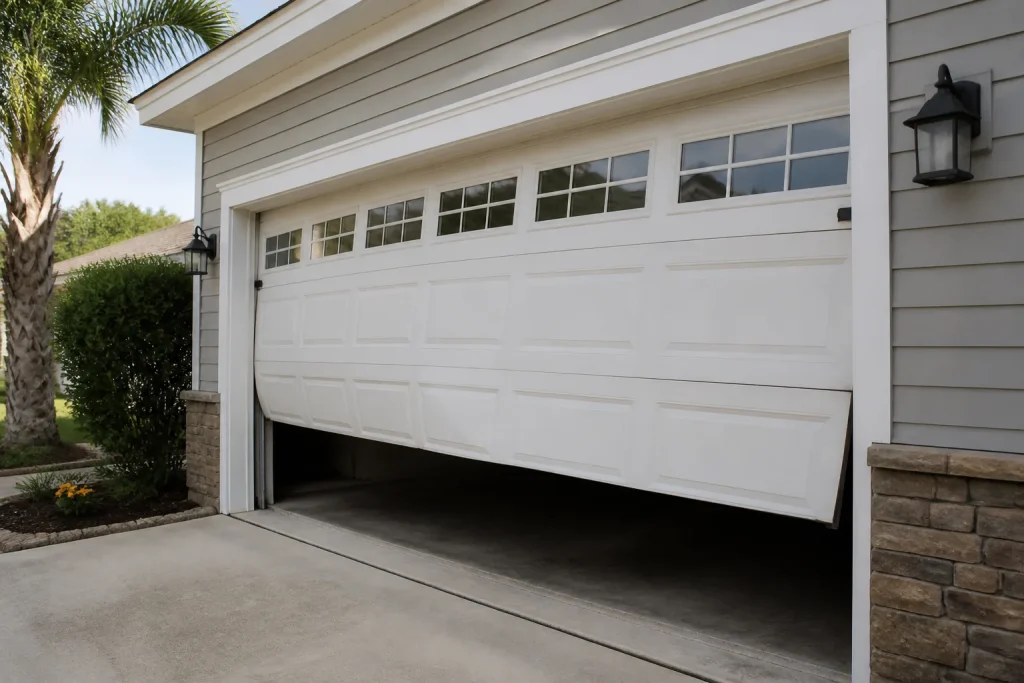
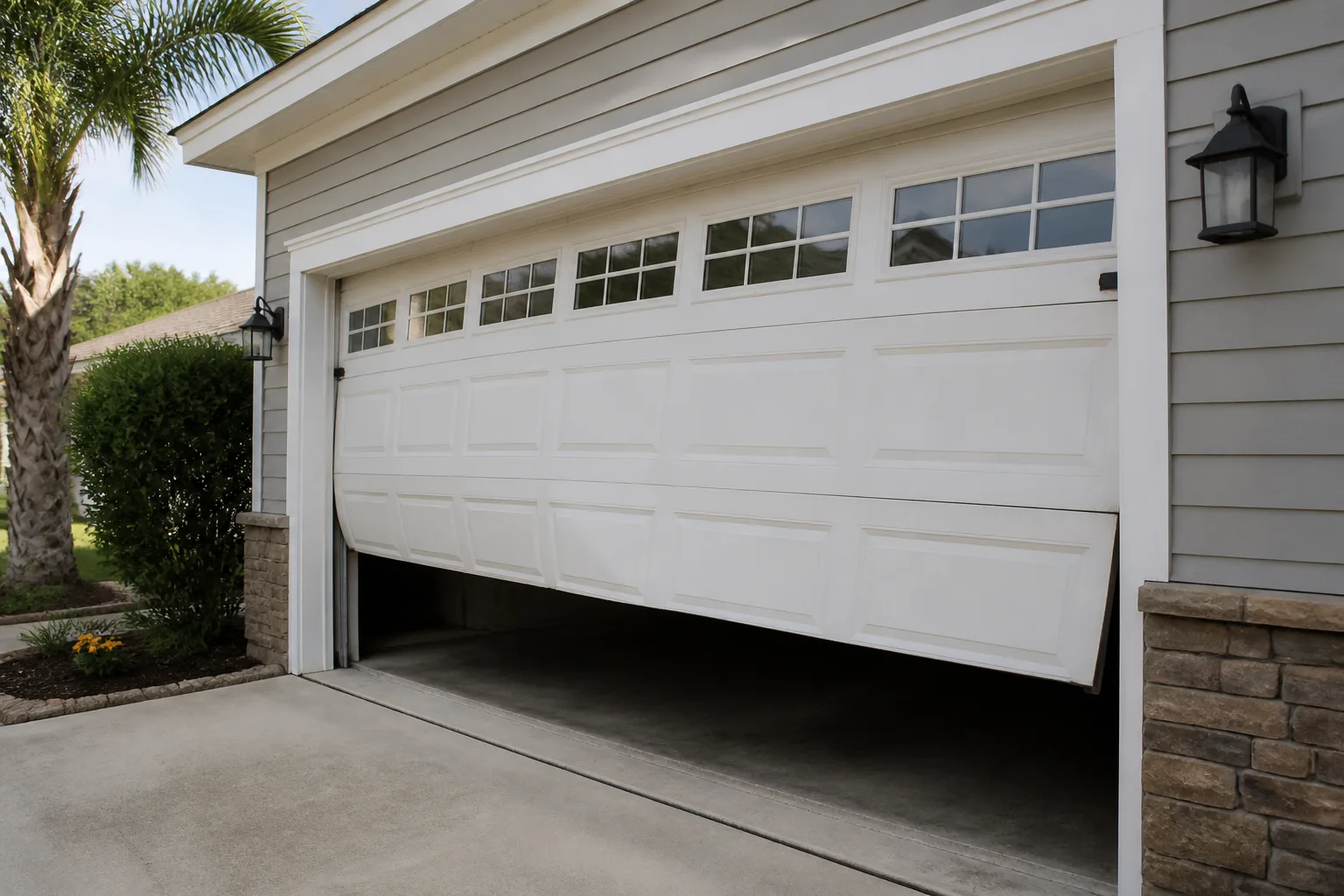
Top Signs You Need Garage Door Service – Don’t Ignore These
A garage door that takes three extra seconds to open fully is not aging gracefully. It’s describing, in mechanical terms, exactly which component is about to fail. Most homeowners hear that delay and tune it out. Technicians hear it and already know what to order. The warning signs of a failing door rarely announce themselves loudly – they show up as small changes in sound, speed, and balance that get blamed on “just getting old” until the door stops moving altogether. Catching them in order means fixing a $90 roller instead of a $400 cable and drum set. If you’d rather leave the diagnosis to someone who does this every day, call (866) 481-7215.
Key Takeaways
- A door that opens slowly is telling you something specific, not just showing its age.
- Sound changes run in order: normal, then aging, then call today.
- A monthly balance test can predict spring failure weeks ahead of time.
- Frayed cables are the highest-risk delay a homeowner can make.
- In Fruit Cove’s humidity and UV, sagging panels and rusted torsion bars show up earlier than most checklists suggest.
Why Is My Garage Door Suddenly Opening So Slowly?
A slow open usually points to one of three things: worn rollers, a tension imbalance in the springs, or an opener that’s straining to lift more weight than it was set for. You can often narrow it down from outside the garage without touching anything. Watch the door travel for the first few feet. If it moves sluggishly from the moment it starts and the panels wobble side to side, worn nylon rollers are the usual culprit – they flatten and drag, and the whole door rides rougher. If it starts slow and then speeds up partway through the climb, that’s a spring losing tension, and the opener is picking up the slack it wasn’t built to carry.
A door that lurches or stutters in one spot often has a roller that’s jumped its track or a hinge that’s binding. Listen while it runs. A steady opener with a straining motor sounds different from a motor that’s working easily – the tone gets higher and more labored, and you’ll notice the light dim slightly as it pulls.
In our experience, homeowners in Fruit Cove tend to notice the slow open before anything else, simply because the door is the first thing they use every morning. It’s the cheapest signal to catch. A roller swap is a small repair. Ignored tension imbalance turns into a snapped spring and a door that won’t budge. If your door has developed a delay and you’d rather have it looked at than guess, garage door repair starts with a free estimate.
What Does a Garage Door Sound Like Right Before It Fails?
Sound is the earliest and most honest diagnostic you get. Most doors pass through three stages, and the difference between them is real. A healthy door is boring. You hear the opener’s motor, a soft roll of the panels, and a light thunk at the end of travel. Nothing rattles, nothing scrapes, and the same rhythm holds every time.
An aging door adds texture. Squeaks on the hinges. A dry groan from the torsion bar as it winds. A rattle from a loose bolt somewhere in the track. These are usually just lubrication and tightening, and they belong in the “fix this soon, it’s cheap” category.
Then there are sounds that mean stop using the door until someone looks at it:
- A sharp snap or bang from above the door, followed by the door refusing to lift – that’s a torsion spring breaking, and you should not run the opener after it.
- A popping or grinding that gets louder with each pass – a roller has failed or left the track, and the panels are now fighting each other.
- A rhythmic thumping at one spot on the track – a bent track or a hinge that’s come loose, which can drop the door if it progresses.
- A cable whipping or slapping sound – a cable is loose, and that is a call-today sound.
If you hear any of the last four in Fruit Cove, stop running the door and call. We answer 24/7. Fast dispatch from 7am to 7pm, Sunday through Friday.
The 30-Second Balance Test That Predicts Spring Failure
You can check the health of your door’s springs once a month without any tools. It takes about 30 seconds, and it catches a spring losing tension weeks before the door breaks. Here’s how:
- Close the door fully.
- Pull the manual release cord to disconnect the opener. The door should be fully supported by its springs at this point.
- Lift the door by hand to about waist height, then let go.
- Watch what it does.
A healthy door holds its position or drifts down only slightly. A door that sags on its own, drops fast, or feels heavy to lift is a door whose springs are already weak or imbalanced. The heavier it feels, the less time you have before the opener starts doing work it shouldn’t and one of the springs gives out.
Reengage the opener when you’re done. If the door dropped hard, don’t run it – a weak spring can snap, and a snapped torsion spring is a serious safety event, not a minor inconvenience. Never try to adjust or replace one yourself. That’s the single most dangerous component on a garage door, and it belongs with a trained technician. Our technicians have up to 11 years of experience with garage door spring repair and can check balance and tension on the spot.
Why Is Cable Fraying the Most Dangerous Sign to Ignore?
A frayed cable is the highest-risk delay a homeowner can make. Not because the cable is expensive to replace – because the failure is sudden and the door becomes unpredictable when it happens. Cables work under tension and hold the full weight of the door. A cable that snaps while the door is up can let the panels drop or swing out of the track, which is where injuries happen.
You can usually see fraying before it fails. Look at the cable that runs along the sides of the door and up to the drum at the top. A healthy cable is one smooth, tight line. A failing cable has:
- Small wire strands poking out of the braid like a frayed rope
- A section where the cable looks thinner or flattened
- Rust spots or kinks, especially near the drum or the bottom bracket
- A cable that looks loose or drooping instead of taut
If you see any of that, stop using the door. Do not try to rewind or reattach a cable yourself – the tension can release without warning. Call for service and have it handled by someone trained for it.
This one matters more in Fruit Cove than in drier climates. The humidity here quietly corrodes cables and torsion bars, and the first visible sign is often rust at a point where the metal is already weakened. If you see rust on a cable, treat it as a cable at the end of its life. Replacing a cable early is a modest repair. Chasing a door that dropped is not.
What Florida Warning Signs Get Left Off Generic Checklists?
Most “signs you need garage door service” lists are written for a national audience. In Fruit Cove, three local signals show up that those lists tend to miss.
Sagging door sections from UV wear. The Florida sun is hard on garage door panels, especially painted steel and wood. Over time the paint chalks, the panel surface dulls, and the panel begins to sag slightly in the middle. You’ll spot it when you look at the door from the end and see a wavy profile instead of a straight line. Sagging panels rub, jump their rollers, and strain the opener – so it’s worth catching early, before replacing a section becomes a whole-door decision. Clopay and Amarr panels hold up well here, but no panel lasts forever in this sun.
Rust on the torsion bar and hardware. In our experience, this is the one local signal homeowners don’t think to check. Humidity here is working on your torsion bar, springs, and hinges every day. Look for orange-brown staining on the torsion bar above the door and on the hinges and bearings. A dusting of rust can usually be cleaned and the hardware re-greased. Pitting or flaking metal is a sign the component is losing strength, and it’s time for a professional look.
Weatherstripping that’s letting pests in. The rubber seal along the bottom of the door and the sides is your first line of defense, and Florida heat cracks it faster than most people expect. When the seal fails, you’ll start seeing light under the door, small gaps at the corners, and palmetto bugs or ants finding their way in. If that’s happening in Fruit Cove, the seal is shot. Replacing weatherstripping is a small, quick fix – and it’s a good early sign that other rubber and plastic parts need a look too.
When to Call a Pro Instead of Waiting
Some fixes are routine maintenance: lubricate the hinges, tighten a track bolt, replace weatherstripping, swap a roller. Others need a trained technician – broken springs, unbalanced doors, frayed cables, bent tracks, and any door that won’t move or won’t close all the way.
If your opener has started running but the door doesn’t move, or the door cycles partway and reverses, that’s a system problem, not a maintenance one. We work on LiftMaster, Chamberlain, Genie, Clopay, Amarr, Wayne Dalton, Craftsman, and Raynor, so if your door or opener is one of those, we already know the equipment. Diagnosing an opener issue usually means looking past the opener itself – a dead opener is often the last symptom of a door that’s been straining for weeks.
If you’re in Fruit Cove and need help, call (866) 481-7215. We answer 24/7. Fast dispatch from 7am to 7pm, Sunday through Friday. A call outside dispatch hours is booked into the next opening, Sunday through Friday, 7am to 7pm. If you’d like to know more about what we do, start with Fruit Cove Garage Door Repair.
The Bottom Line
Start with the balance test. If the door holds steady, watch for the slow-open signal – it usually means rollers or springs, and catching it early keeps the repair small. Then listen. Any snap, grind, or cable whipping is a stop-and-call signal. In Fruit Cove, add UV sagging, rust on the torsion bar, and a failed weatherstripping seal to your monthly check; they show up here sooner than generic checklists suggest. Fixing a $90 roller today is a lot cheaper and safer than replacing a $400 cable and drum set next month.
If you’re in Fruit Cove and need help, Fruit Cove Garage Door Repair offers free estimates – call (866) 481-7215. Every price is quoted and agreed before any work starts, so you’ll know the number before we touch the door.
Related services in Fruit Cove: garage door opener repair.
Frequently Asked Questions
Spring repair is quoted per job, not per hour. A single spring replacement is one price; a matched pair replaced together is roughly double, since both are usually replaced at the same time. The written estimate sets the final price, and it’s provided before any work starts. Call (866) 481-7215 for an exact quote – estimates are free.
Yes, for urgent issues we can often get to you the same day. A door that won’t close, a broken spring, or a cable that’s snapped is exactly what our emergency garage door service is for. Call (866) 481-7215. We answer 24/7. Fast dispatch from 7am to 7pm, Sunday through Friday.
No. We quote the job in writing and agree the price with you before any work begins. If we find something that needs a different repair, we’ll tell you and get your approval first. What you agree to is what you’re billed.
The local pros we connect you with are licensed and insured as their state requires. Our technicians have up to 11 years of experience, and we specialize only in garage doors – not general handyman work. Call (866) 481-7215 for a free estimate.
Written by the team at Fruit Cove Garage Door Repair.
Need Garage Door Help?
Call Fruit Cove Garage Door Repair - the local pro we connect you with is licensed and insured, here with fast help in Fruit Cove.
(866) 481-7215